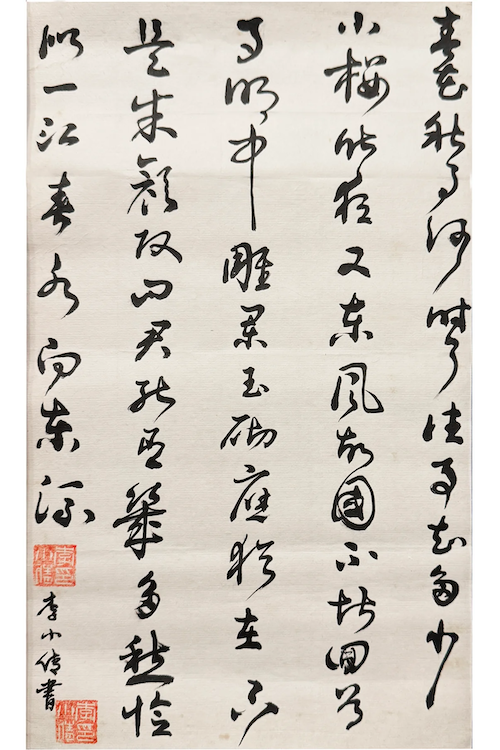
 Calligraphy by Xiaoqian LI
Calligraphy is the art of forming the written signs of a language. Chinese calligraphy stands out for the originality and richness of Chinese writing 汉字 . Chinese calligraphy thus offers a very broad field of expression.
The best-known form of Chinese calligraphy is that practiced with a brush. Chinese schoolchildren also learn to write Chinese characters 汉字 neatly with a ballpoint pen or a fountain pen: this calligraphy is called fountain pen calligraphy (not a very surprising name, it must be said!). Those who excel at brush calligraphy usually do not have good fountain pen calligraphy and vice versa, due to the flexibility required in the wrist.
In ancient times, Chinese characters 汉字 were carved into ox bones or tortoise shells, then onto bronze objects. Later, books were made from bamboo slats bound together. A bamboo pen and soot ink were certainly used for writing. Bamboo pens are still sometimes used today.
Brush calligraphy is practiced on rice paper or silk (which is more fragile). A calligrapher's tools are called the Four Treasures of the Study 文房四宝 . These are the brush, paper, ink, and inkstone. Ink comes in the form of a stick that is rubbed on the inkstone with water to produce liquid ink. Nowadays, ink is also available in small bottles, which is much more convenient and of good quality. However, this method does not allow for all the desired ink densities.
Good calligraphy was traditionally a reflection of a scholar's level of culture. A good doctor had to be a good calligrapher 书法家 (yikes!) and imperial examinations to become an official placed more emphasis on the candidate's calligraphy than on the content of their essay!
The history of Chinese writing 汉字 (over 3,000 years old!) has led to the development of numerous calligraphic styles. To this are added the different ways a character can be written: on average, three per character. For example, the character for happiness 福 has over a hundred different forms. The calligrapher therefore already has a vast range of possibilities. They can also vary the thickness and thinness of strokes to express emotions. They can write certain characters in a text differently to emphasize or alter their meaning. In short, the message that Chinese calligraphy can convey is vast. Some even take it to complete abstraction.
To learn Chinese calligraphy, it is best to know the basics of Chinese writing 汉字 ; otherwise, you will have to learn it as you go. One starts by studying the fundamental strokes, then moves on to writing characters in the regular style 楷书 . Next, one learns the running style 行书 , and finally, the very cursive grass style 草书 . The Chinese say that the regular style is like standing, the running style is like walking, and the grass style is like running.


