Source: © Learn-chinese.online
Mandarin is reputed to be a difficult language to learn. Although this opinion is exaggerated, it is not entirely false. Learning Mandarin therefore represents a certain investment in time and energy. It is therefore natural to wonder why it is interesting (sometimes necessary) to learn Mandarin. After analyzing the different possible reasons and motivations, it is of course necessary to ask how to optimize learning in terms of both time invested and the quality of skills acquired. This article aims to be a clear and complete analysis of these two questions.
Why learn Mandarin?
Here are the different reasons that push people to learn Mandarin as I have encountered among my students and students:
- Given the current situation in the world and the place of the Chinese economy in the international context, one of the first reasons to learn Mandarin is indeed the professional one. Mastering the language of the world's second-largest economy and especially the leading industrial power is not insignificant on a CV. Whether to join a company or integrate a prestigious school, Chinese is an often underestimated asset. The examples I have encountered during my teaching career are sometimes surprising: for example, this student who wanted to join an engineering school after a gap year (to have fun and not to acquire linguistic and cultural skills abroad...) and who was in competition with two other candidates for a single spot. This student had a slightly weaker file than the two others and had not even finished his Chinese course (2 years instead of 3 for LV3 in France). But because he had already studied Chinese, he was the one selected. Similarly, in the police or in the army, mastering Mandarin offers interesting promotion opportunities. The examples are countless, and anyone integrated into the professional world or higher education can confirm this.
- Another important reason to choose Mandarin is the cultural aspect. It is true that the best way to understand a culture is through its language. Idioms, different vocabularies, the way to express an idea differ from one language to another. However, Chinese culture is incredibly rich, both in literature, painting, calligraphy, music, and all arts in general. China even has an original medicine that is easily understood in Chinese, while it seems so strange when discussed in our Western languages. And we must not forget that China has a history that goes back to the second millennium BC on a territory larger than Europe!
- Another reason to learn Mandarin is its difficulty. For some, this represents a real challenge that is well worth taking on. Personal pride obliges.
- The difficulty of Chinese is mainly due to its writing, which does not indicate pronunciation like an alphabet. Learning Chinese therefore requires particular exercises that engage the right brain independently of the left brain. I have heard (but I have little information on this subject; if you have any, do not hesitate to let me know via contact) that dyslexic people were able to resume their studies thanks to learning Chinese. The mental exercises required to learn Chinese would be like therapy.
- Finally, another reason to learn Mandarin is the humanist reason. Understanding the other and seeking to communicate in a sincere and respectful dialogue is an essential condition for peace and mutual understanding. However, learning the other's language, seeking to know their culture, is indeed the first step in this dialogue. This (unfortunately!) is a reason rarely mentioned for learning Chinese. However, there are more than 1.3 billion Chinese people. They often feel misunderstood or even humiliated by Westerners. Moreover, China is already a superpower, and experts agree that it will not stop there. Learning Chinese is not just a "plus" that one can selfishly look at for a professional promotion, but rather an opening to the other, who seems so distant but is actually so close.
How to learn Mandarin?
To efficiently optimize the learning of Mandarin, it is necessary to establish a learning strategy from the start. This strategy is defined by the rules for learning a foreign language in general and especially by the specific difficulties of the Chinese language.
Definition of problems related to learning Mandarin
A language is first spoken before it is written. It is therefore appropriate to start by learning the essential elements of meaning: words. It is then necessary to learn how to combine these words to produce understandable statements: sentences. This is where grammar comes into play. For this, it is necessary to memorize "model sentences" that will engrave these structures in our memory and allow us to reuse them quickly in an authentic context. It is enough to change one or two words in these model sentences to be able to make a wide variety of different sentences. These automations are therefore very important. Finally, it is necessary to learn the particular expressions of the language, which are often closely linked to the cultural context.
Another very important thing for learning a foreign language: it is necessary to have specific goals. One is often disoriented by the variety of methods and their content. It is therefore necessary to have specific goals both in terms of vocabulary lists and grammar points, and linguistic skills. These goals are often defined by language certificates (Ielts for English, HSK for Mandarin, etc.). Analysis of PISA test results shows that countries with the best results, among other things, have programs with specific goals. We observe in our Western countries an opposite tendency due to certain "pedagogical fads".
We have just defined the general learning rules for a foreign language above. Now, we need to specify what the specific difficulties of Chinese are.
The big problem with learning Mandarin is that the main difficulties are all at the beginning and it is difficult to avoid one or the other.
The first difficulty is pronunciation. Mandarin is not a rich language from the oral point of view. There are not many phonemes. However, some do not exist in French, and above all, Chinese syllables are accented: each syllable can have four different intonations (plus the absence of intonation), which consist of a variation between grave and acute. This does not exist in French, and it takes enough time to train the ear and even more to be able to reproduce them.
The second difficulty is related to the first: since Chinese characters do not indicate pronunciation, we use a phonetic transcription called pinyin. A century ago, each country had its own phonetic transcription of Mandarin. In 1979, China and ISO (International Organization for Standardization) officially adopted pinyin (which had already been approved in 1958). However, this transcription in Latin characters is not pronounced like French. For example, "r" is pronounced like our "j", "i" is sometimes pronounced "i" and sometimes "e", etc. It is therefore necessary to learn to read pinyin correctly from the beginning.
In addition to the difficulties of the spoken language, there are those of the written language. It is necessary to learn a new writing system, very different from ours. The characters are numerous, and it is difficult to memorize them all.
Finally, the grammar of Chinese, which is very simple and logical in itself, does not resemble ours. There is no subject inversion for questions, no conjugation, etc.
Setting up a learning strategy for Mandarin
First, it is necessary to learn vocabulary. It is surprising to note that many language methods start with the lesson text. The learner will therefore logically go a few pages further to look for the vocabulary and do a kind of back and forth between the text, vocabulary, and grammar. All the difficulties thus accumulate, which is often discouraging. It is therefore necessary to learn vocabulary first, even if it is not retained at 100%, the fact of having already seen it will facilitate the rest of the learning process.
It is the oral vocabulary that should be learned first. One should not read the pinyin (phonetic transcription) right away, but first listen carefully to the recording and repeat each word trying to imitate the Chinese speaker. Then, one can analyze the pinyin and discover which sound corresponds to which transcription.
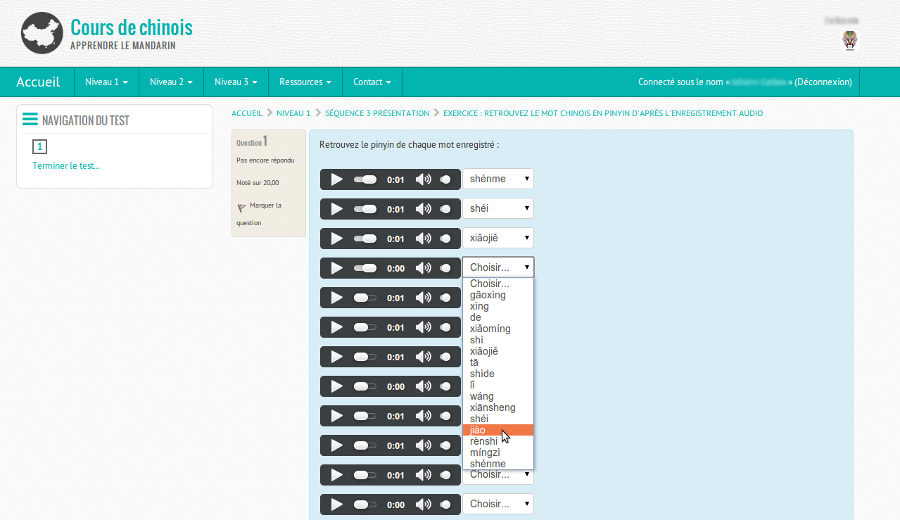
To facilitate the learning of oral vocabulary, the website Learn-chinese.online offers various dynamic exercises. For example, associations of recordings with pinyin transcriptions:
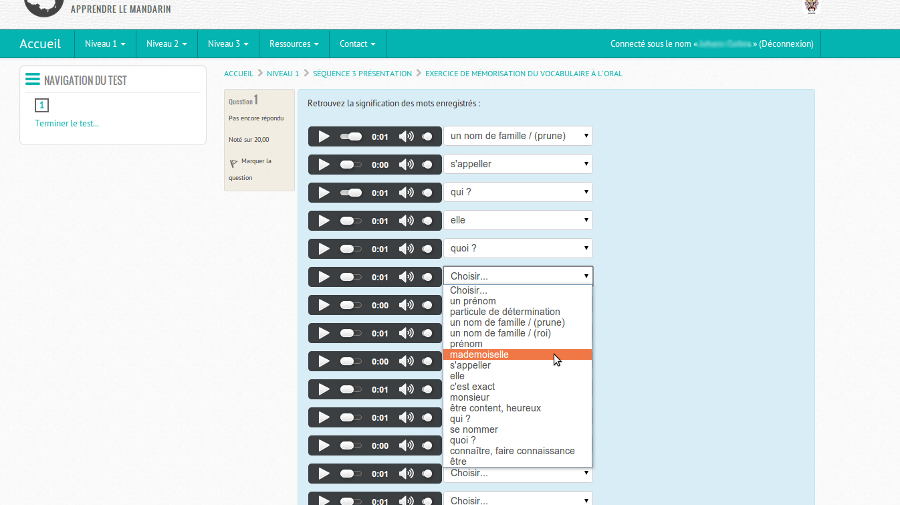
Then, an exercise to memorize oral vocabulary:
Next, it is necessary to learn writing. In Chinese, a word can be composed of one, two, or three characters, sometimes more but rarely. It is better to learn each character separately. For each character, it is necessary to remember its meaning, its pronunciation, the order of writing the strokes, and the direction of each stroke. The order of writing and the direction of each stroke follow precise rules: Chinese writing rules. Care must be taken at the beginning to respect the order of the strokes to not make the characters unreadable later. At the end of level 1 of the Mandarin courses, the writing order becomes natural. A Chinese character is composed of fundamental characters called "key," "radical," or "graphic element." It is highly recommended at the beginning to learn these graphic elements as this simplifies the memorization of characters later.
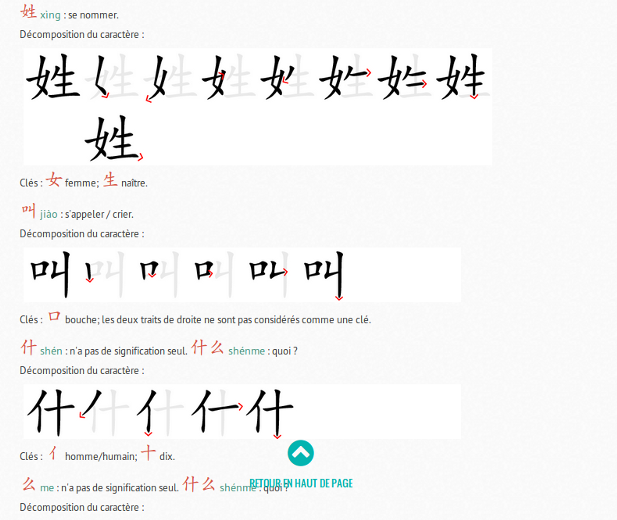
As with oral vocabulary learning, Learn-chinese.online offers various dynamic exercises. For example, associations of words in characters with French:
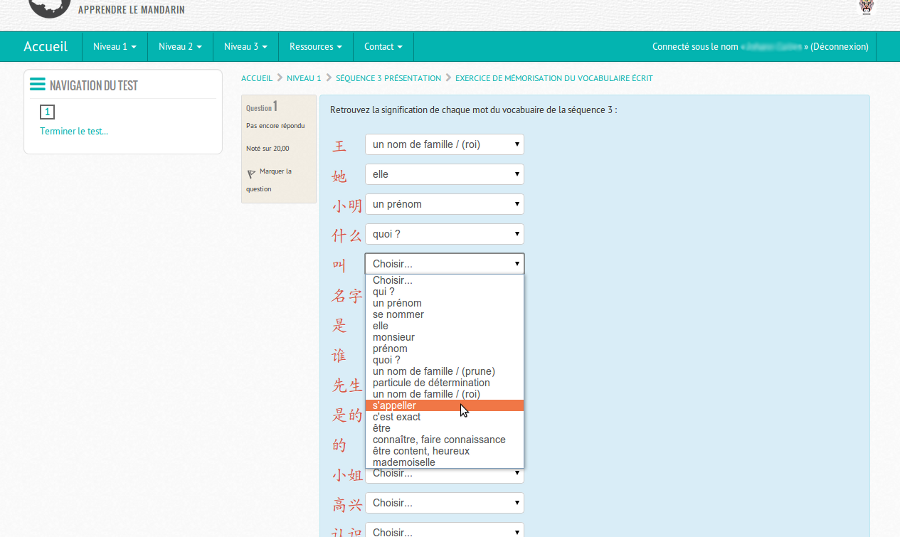
As well as other exercises such as character-pinyin or character-audio associations.
These dynamic exercises greatly facilitate vocabulary memorization because the brain's gymnastics are guided by the interactive aspect of the website. It is no longer necessary to force yourself in front of an inert piece of paper.
An important exercise at the beginning of Chinese learning is the copying of lines of characters. For each sequence, the website Learn-chinese.online provides writing grids to download and print with all the characters of the sequence:
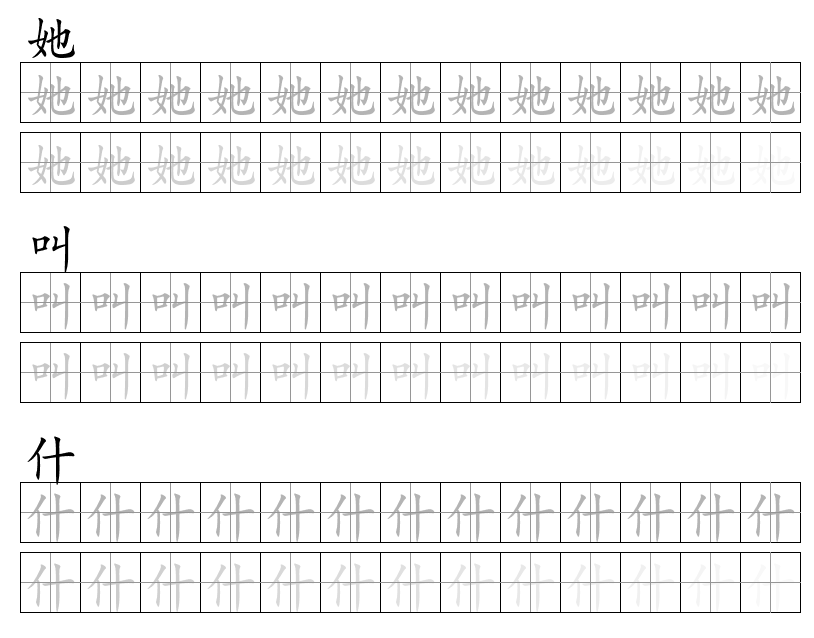
When vocabulary is assimilated, one can move on to grammar with clear and precise explanations:

Then, it is necessary to memorize model sentences:
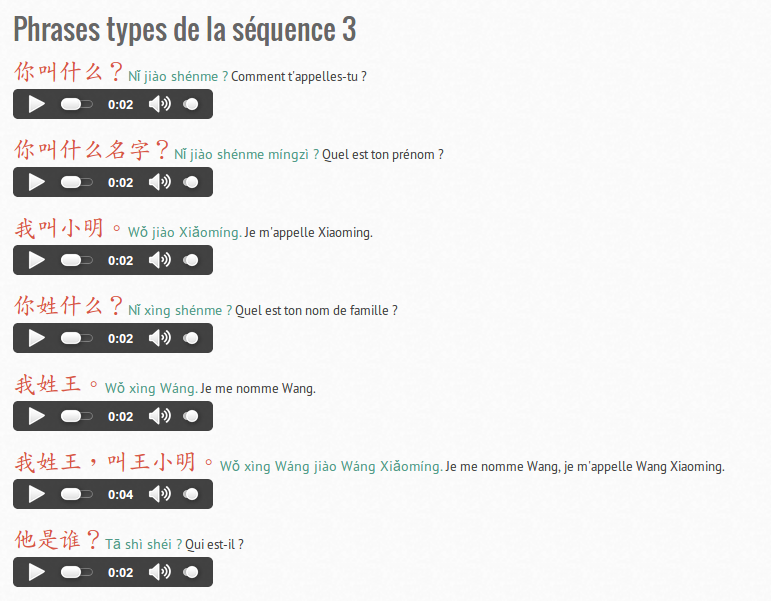
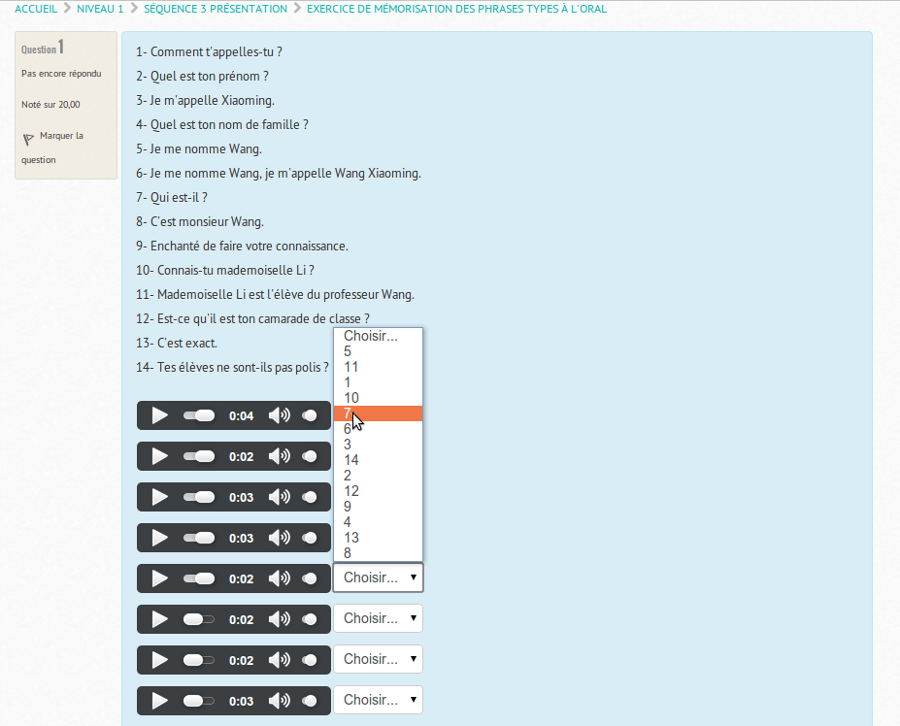
As with vocabulary, the website Learn-chinese.online offers dynamic exercises to memorize model sentences orally:
and in writing:
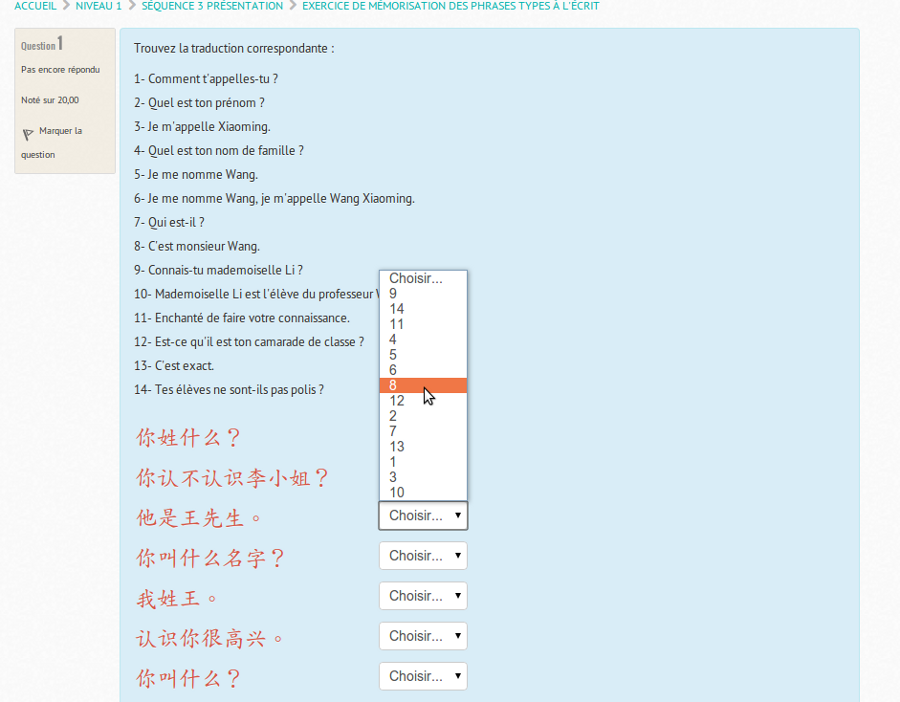
Then, one must combine one's knowledge by studying the text or a dialogue:

We also mentioned that it is necessary to have specific goals to optimize the learning of a foreign language. The website Learn-chinese.online has chosen to organize its courses according to the goals of the Chinese language certificate (HSK), which is the best way to have one's Chinese level recognized internationally. HSK is an objective test mainly based on multiple-choice questions. Its programs are very precise. Taking it year after year is an excellent way to verify (and especially to validate!) one's Mandarin level.
This is why the website Learn-chinese.online offers synthesis assessments based on the HSK test model:
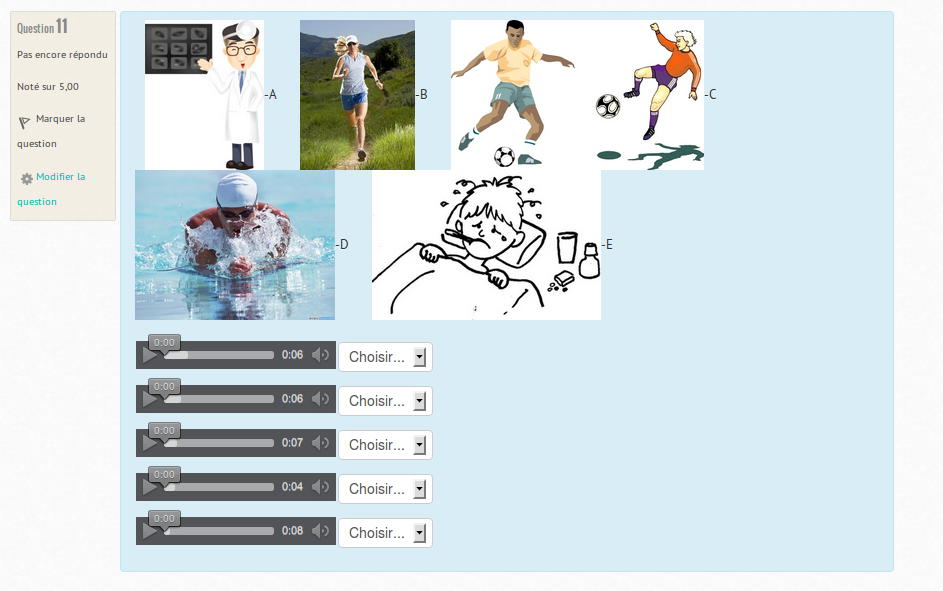
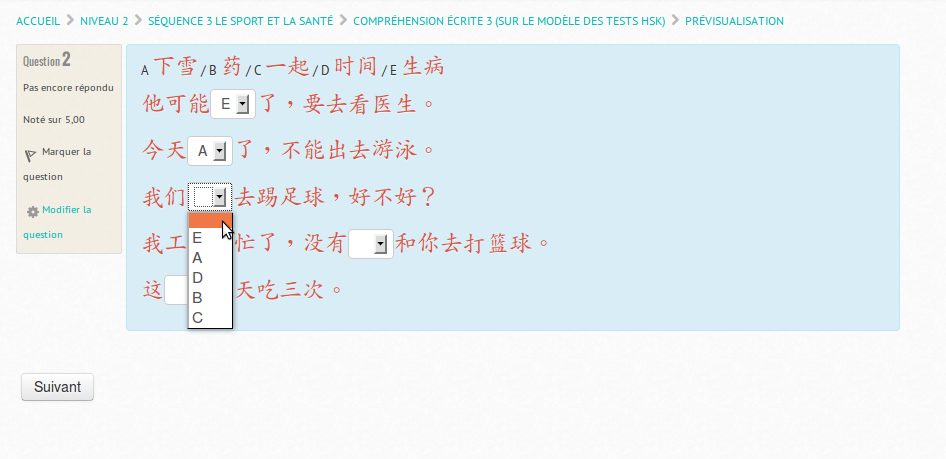
Each sequence of each level presents an oral comprehension assessment and a written comprehension assessment based on the HSK test model (except for the first three sequences of level 1, because the volume of knowledge is insufficient to take a complete test). This makes it possible to activate the recently acquired knowledge, review the knowledge of previous sequences, and practice for the HSK test for those who wish to take it.


