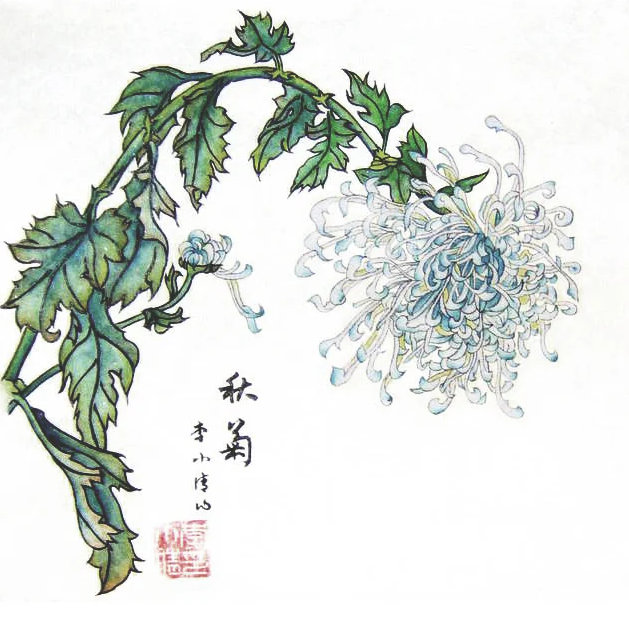
 Xiaoqian Li's Blue Chrysanthemum
Chinese painting (Chinese: 中国画 Zhōngguó huà) is the traditional pictorial art practiced in China for over a thousand years. Its roots draw from a much older original thought that emphasizes the unity of man and the cosmos, as well as the uninterrupted dynamism of this universe itself. More than the representation of a form, Chinese painting seeks to express the soul (life principle), the internal movement of beings.
In general, Chinese painting consists of one or more poems (Chinese: 诗 shī), calligraphies (Chinese: 书法 shūfǎ), a painted image, and the artist's seal (Chinese: 印章 yìnzhāng). Various methods should be distinguished:
- Chinese Gongbi painting (Chinese: 工笔 gōngbǐ, literally "Careful brush" or "Skillful brush") is distinguished by its finesse and precision in detail.
- Chinese Baimiao painting (Chinese: 白描 báimiáo, literally "Line drawing") only draws the outlines in black ink. It is related to Gongbi (Chinese: 工笔).
- Chinese Mogu painting (Chinese: 没骨 mògǔ, literally "Boneless") resembles Gongbi (Chinese: 工笔), but unlike it, it does not draw the outlines.
- Chinese Xieyi painting (Chinese: 写意 xiěyì, literally "Writing the idea" or "Writing the intention") is characterized by bold strokes and mainly uses the principle of gradients.
- Chinese Shuimo painting (Chinese: 水墨 shuǐmò, literally "Ink and water") is a style of Xieyi (Chinese: 写意), but is created only in black ink, playing on nuances.
- And many others that are generally variants of the styles already mentioned.
The goal of Chinese painting is to create, with the greatest conciseness, a work of artistic charm bearing a meaning that touches the infinite. Indeed, in traditional Chinese thought, the universe is composed of breaths (Chinese: 气 qì) of various densities and always in motion, the very source of life. Recreating these breaths in an image gives it life and establishes a direct link between the universe, the painting, and man. Thus, the act of painting or contemplating a painting allows one to rediscover the unity, often lost, with the cosmos. In this, Chinese painting is more an art of living than a mere aesthetic work. "Rhythm of Qi and Vital Movements" is an excellent expression to grasp the meaning of Chinese painting.
The formats used in Chinese painting are very varied. The best known are "the large scroll" (Chinese: 大轴 dàzhóu), "the horizontal format" (Chinese: 横幅 héngfú), "the fan" (Chinese: 扇面 shànmiàn), etc.
The subjects include human figures (Chinese: 人物 rénwù), landscapes (Chinese: 山水 shānshuǐ), flowers and birds (Chinese: 花鸟 huāniǎo), mammals (Chinese: 走兽 zǒushòu), insects and fish (Chinese: 虫鱼 chóngyú), architecture (Chinese: 建筑 jiànzhù), etc. Sources of inspiration are therefore found directly in nature, but also in the paintings of ancient masters.
Landscapes (Chinese: 山水 shānshuǐ), human figures (Chinese: 人物 rénwù), and flowers and birds (Chinese: 花鸟 huāniǎo) are the three favorite themes of Chinese painters. This implies a thorough study of plants and flowers according to the four seasons, as well as the physiognomy of birds, insects, fish, and mammals. One must also develop their sense of observation while keeping in mind traditional thought to perceive the dynamism through an apparently static landscape.
The essential points of the composition of Chinese paintings are:
- The overall organization and directions (ascending, descending, leaning, etc.).
- Density and grouping (or dispersion). The ancients, to give an image of the density of a painting, used this expression: "Spaced so that a horse can pass through, dense so that even the wind cannot penetrate."
- The void (Chinese: 空 kōng). In traditional Chinese painting, the void occupies a very important place. It can represent the sky (Chinese: 天 tiān), the earth (Chinese: 地 dì), water (Chinese: 水 shuǐ), clouds (Chinese: 云 yún), etc. It allows to give an image in the painting, but also to project the viewer into a much vaster, even infinite world, by letting their imagination run wild. Contemplation relies on the "full" part of the painting as a springboard to propel itself into the absolute through the "void" part. Chinese poems are based on the same principle.
- Even more important are the inscriptions (Chinese: 题字 tízì). They include the title, the content (poem, prose, description, story, etc.), the author's name, and their seal. Everything must be calligraphed in different styles according to what the artist wishes to express. The choice of inscriptions and their positions depends on the life of the painting. It is they who complete the work. Without them, Chinese painting is but a body without a soul.


